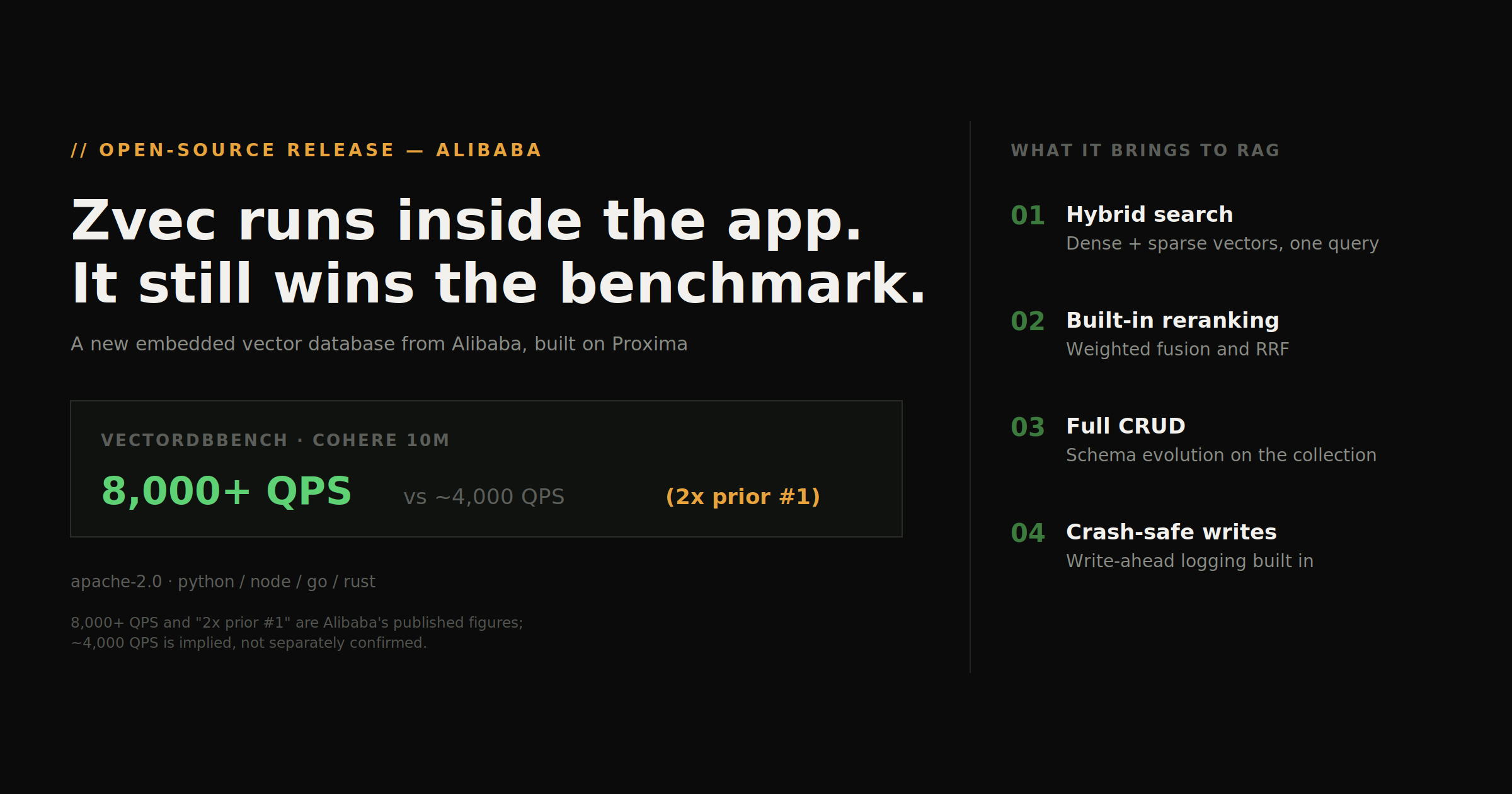
Alibaba just open-sourced Zvec, a new in-process vector database that targets the growing class of local AI and retrieval-augmented generation workloads. Zvec is positioned as the “SQLite of vector databases”: it runs inside your app, avoids a separate service layer, and brings vector-native search, hybrid filtering, and persistence into a single API.
What makes Zvec different
Most vector database conversations today split into two camps:
- index libraries like Faiss and Annoy, which are fast but not a complete database
- service-based systems like Milvus, Pinecone, and managed cloud vector engines, which add infrastructure overhead
Zvec sits between them. It is:
- in-process — no external daemon, no RPC, no separate deployment
- embedded — your app opens a collection on disk and queries it directly
- vector-native — built on Alibaba’s Proxima engine, designed for similarity search at scale
- durable — write-ahead logging (WAL) and crash-safety are built in
That design makes it a better fit for desktop agents, local RAG pipelines, edge applications, and developer tools where running a separate vector service is too heavy.
A realistic local RAG workflow
The Zvec quickstart is intentionally short. You define a collection schema, create or open a collection on disk, insert docs with vectors, and query by similarity.
import zvec

schema = zvec.CollectionSchema(
    name="example",
    vectors=zvec.VectorSchema("embedding", zvec.DataType.VECTOR_FP32, 4),
)

collection = zvec.create_and_open(path="./zvec_example", schema=schema)

collection.insert([
    zvec.Doc(id="doc_1", vectors={"embedding": [0.1, 0.2, 0.3, 0.4]}),
    zvec.Doc(id="doc_2", vectors={"embedding": [0.2, 0.3, 0.4, 0.1]}),
])

results = collection.query(
    zvec.VectorQuery("embedding", vector=[0.4, 0.3, 0.3, 0.1]),
    topk=10,
)
print(results)
That alone is enough to build a local semantic search or RAG retriever on top of any embedding model. Zvec’s promise is that the same engine can also handle richer production-level retrieval scenarios.
What Zvec brings to the RAG table
Zvec is not just a local index. The feature set is tuned for real retrieval pipelines:
- full CRUD on documents so knowledge bases can evolve
- schema evolution for index and field changes over time
- dense + sparse vector support in the same query
- hybrid search combining vector similarity, text, and structured filters
- multi-vector retrieval for multi-embedding signals
- built-in reranking with weighted fusion and Reciprocal Rank Fusion
- scalar filters pushed into the index execution path
Those capabilities make Zvec more than an embedded ANN engine. It is a local database for retrieval workloads that need both semantic relevance and structured precision.
Performance claims to note
Alibaba publishes benchmark results showing Zvec reaching more than 8,000 QPS on the Cohere 10M dataset with matched recall. That metric puts it ahead of many cloud-managed systems on the same benchmark.
The engine also emphasizes efficiency:
- CPU-optimized execution
- multithreading and prefetch-friendly layouts
- configurable resource control via
concurrency,optimize_threads, andquery_threads - optional disk-backed indexes for larger-than-memory datasets
For anyone building an on-device or local AI product, those performance numbers are an important validation of the embedded approach.
Why Alibaba built Zvec
The case for Zvec is easy to understand if you have built local AI tools before:
- external vector services add latency and deployment complexity
- index libraries force you to build your own metadata storage, durability, and filtering
- managed cloud vector engines are overkill for a notebook, desktop app, or edge device
Zvec aims to offer the best of both worlds: a full database experience with the simplicity of a library.
When to use Zvec
Zvec is especially compelling for:
- local knowledge bases in notebooks and desktop assistants
- on-device RAG for privacy-sensitive applications
- edge deployments that need retrieval without a service dependency
- fast experimentation where setup cost matters
- embedding search into existing apps without new infrastructure
If your project already requires multiple backend services, a managed vector cloud may still be the better choice. But if your priority is local simplicity and direct data ownership, Zvec is worth evaluating.
Caveats and what to watch
Zvec is still new, so keep an eye on a few practical risks:
- the ecosystem and connectors are smaller than established vector clouds
- long-term support is tied to Alibaba’s open-source roadmap
- embedded concurrency is read-shared / write-exclusive, so write-heavy multi-process patterns need careful design
Still, the Apache 2.0 license, Python/Node/Go/Rust SDK story, and explicit edge focus make it a credible entry in the vector database landscape.
The big takeaway
Alibaba’s Zvec is not just another vector index. It is a deliberate attempt to make vector search feel like a local database first and a retrieval engine second.
For teams building RAG and semantic search where simplicity, durability, and on-device execution matter, Zvec is the kind of new database worth testing. It does not replace cloud vector services, but it does make the embedded path much more attractive.